
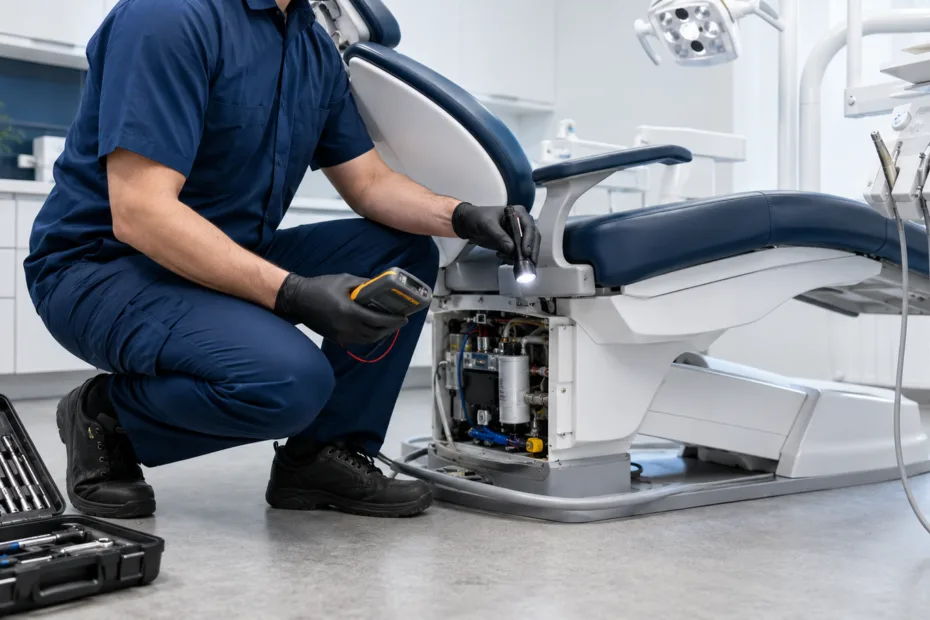
Dental equipment is a major investment, but its true value depends on how reliably it performs throughout its service life. A dental chair that will not move, a sterilizer that displays an error, or a vacuum system that loses suction can interrupt patient care and create unexpected expenses.
A consistent dental equipment maintenance program helps reduce preventable breakdowns, identify developing problems, improve equipment reliability, and protect the investment your practice has made.
This dental equipment maintenance guide explains how to organize preventive maintenance for dental chairs, delivery systems, waterlines, sterilizers, compressors, vacuums, handpieces, X-ray systems, and other essential equipment.
Maintenance requirements vary by manufacturer and model. Always follow the equipment manufacturer’s instructions and applicable federal, state, and local requirements.
Why Dental Equipment Maintenance Matters
Equipment maintenance is sometimes postponed until a problem becomes impossible to ignore. Unfortunately, waiting for equipment to fail can turn a manageable repair into a larger service interruption.
Preventive maintenance can help a dental practice:
- Reduce unexpected equipment failures
- Identify leaks, wear, and damaged components earlier
- Improve equipment performance
- Protect patient and staff safety
- Reduce unnecessary downtime
- Extend the useful life of serviceable equipment
- Maintain consistent clinical workflow
- Protect warranty coverage
- Document compliance-related activities
- Plan repairs and replacements before an emergency occurs
The American Dental Association provides a Dental Equipment Safety Checklist covering items ranging from amalgam traps to X-ray equipment. Practices can use this type of checklist as a starting point for developing their own maintenance program.
Create a Complete Equipment Inventory
The first step is knowing exactly what equipment the practice owns.
Create an inventory containing:
- Equipment category
- Manufacturer
- Model number
- Serial number
- Location or operatory
- Installation date
- Purchase date
- Warranty expiration
- Supplier information
- Service-provider information
- Maintenance requirements
- Previous repairs
- Replacement parts used
- Software version, when applicable
- Manufacturer’s instructions for use
Photographing the identification label on each major piece of equipment can make it easier to request parts or technical assistance later.
Store operating manuals, wiring diagrams, service records, purchase documents, and warranty information in a central digital or physical location. Staff should know where these records are kept.
Establish Maintenance Responsibilities
A maintenance program works best when individual responsibilities are clearly assigned.
Designate team members to:
- Complete daily inspections
- Maintain sterilization records
- Monitor dental-unit water quality
- Check vacuum traps and filters
- Report leaks or unusual equipment behavior
- Schedule professional service
- Maintain the equipment-service log
- Track warranties and recurring maintenance dates
Clinical staff may perform approved cleaning, inspection, and user-level maintenance. Repairs involving electrical systems, internal components, pressurized equipment, radiation-producing equipment, or safety systems should be handled by qualified personnel.
Follow the Manufacturer’s Instructions
Avoid creating one universal maintenance procedure for every product. Two pieces of equipment that perform the same function may require different cleaners, lubricants, replacement intervals, or service procedures.
Manufacturer instructions may specify:
- Approved cleaning products
- Disinfectant compatibility
- Lubrication requirements
- Filter replacement intervals
- Waterline-treatment procedures
- Sterilization parameters
- Inspection points
- Approved replacement parts
- Required calibration
- Professional service intervals
Using an incompatible chemical can damage upholstery, plastics, tubing, seals, paint, and electronic controls. Using an incorrect lubricant or replacement part can also affect equipment performance.
Dental Chair Maintenance
Dental chairs contain mechanical, hydraulic, electrical, and electronic components that must work together. Minor issues should be addressed before they develop into larger problems.
Daily Chair Checks
Before treating patients:
- Confirm that the chair moves smoothly
- Test the foot control and touchpad
- Check programmed positions
- Inspect upholstery for tears or openings
- Check armrests and headrests for secure movement
- Listen for unusual noises
- Look underneath the chair for fluid
- Verify that cords and hoses are not pinched
- Confirm that emergency-stop features are unobstructed
Periodic Chair Maintenance
At intervals recommended by the manufacturer:
- Inspect mounting hardware
- Check pivot points and moving joints
- Examine hydraulic lines and cylinders
- Inspect electrical cords and connectors
- Check limit switches and position sensors
- Examine foot-control operation
- Inspect the chair base and swivel mechanism
- Confirm that accessory arms move properly
Do not continue operating a chair that moves unpredictably, drifts from position, leaks hydraulic fluid, produces electrical odors, or has damaged safety components.
Upholstery Maintenance
Clean upholstery with products approved by the upholstery or chair manufacturer. Harsh chemicals can cause cracking, discoloration, hardening, or premature wear.
Inspect:
- Seams
- Headrest edges
- Armrests
- Seat corners
- Toe-board areas
- High-contact surfaces
Small openings can allow moisture to reach the foam and underlying structure. Replacing damaged upholstery can improve appearance, make surfaces easier to maintain, and help preserve the chair beneath it.
Delivery-System Maintenance
Delivery systems control the air, water, and instruments used during treatment. Maintenance should address both performance and infection-prevention requirements.
Check for:
- Air or water leaks
- Sticking valves
- Damaged handpiece tubing
- Weak syringe air or water
- Irregular handpiece pressure
- Worn O-rings
- Damaged holders
- Contaminated filters
- Loose tray or arm assemblies
- Malfunctioning foot controls
Use only approved replacement tubing, O-rings, valves, and filters. Similar-looking components may have different specifications.
Dental-Unit Waterline Maintenance
Dental-unit waterlines require an ongoing treatment and monitoring program. An independent water bottle by itself does not control microbial contamination.
The CDC recommends treating dental-unit waterlines regularly so that water used for routine dental treatment meets the EPA drinking-water standard of no more than 500 colony-forming units per milliliter of heterotrophic water bacteria. Practices should follow the dental-unit manufacturer’s instructions for treatment and monitoring. Review the CDC’s dental-unit water-quality recommendations.
A waterline program may include:
- Continuous treatment products
- Periodic shock treatment
- Water-quality testing
- Bottle and reservoir cleaning
- Treatment documentation
- Corrective action after unacceptable test results
Treatment products must be compatible with the dental unit. Mixing chemicals or using an unapproved concentration can damage tubing and internal components.
Vacuum and Evacuation-System Maintenance
Dental vacuum systems support high-volume evacuation and saliva-ejection equipment. Declining suction may be caused by a full trap, clogged line, air leak, worn valve, blocked filter, or mechanical-room problem.
Routine tasks may include:
- Cleaning or replacing chairside traps
- Inspecting evacuation tubing
- Checking valves and holders
- Using an approved vacuum-line cleaner
- Inspecting the central vacuum filter
- Monitoring suction performance
- Checking the system for abnormal noise
- Inspecting for leaks
- Servicing the vacuum according to its manual
If the practice uses an amalgam separator, make sure all cleaners are compatible with that separator and comply with applicable requirements.
Avoid using household drain cleaners or unapproved chemicals in dental evacuation lines.
Amalgam-Separator Maintenance
Dental practices that place or remove amalgam may be required to operate and maintain an amalgam separator. The EPA also restricts the disposal of scrap amalgam and the use of certain line cleaners.
Maintenance may include:
- Inspecting the separator
- Monitoring container capacity
- Replacing collection containers
- Confirming wastewater flows through the separator
- Using compatible vacuum-line cleaners
- Documenting inspections and service
- Properly managing collected amalgam waste
Follow the separator manufacturer’s instructions and review the EPA’s current dental-effluent guidelines. Contact the appropriate local wastewater or regulatory authority when compliance requirements are unclear.
Dental Air-Compressor Maintenance
The air compressor supplies clean, dry air to treatment rooms. Compressor problems can affect handpiece operation, air/water syringes, and other equipment throughout the practice.
Maintenance may include:
- Checking operating pressure
- Inspecting the intake filter
- Checking moisture-control systems
- Draining the tank when required
- Inspecting for air leaks
- Cleaning ventilation openings
- Monitoring operating temperature
- Checking the dryer
- Listening for unusual cycling or vibration
- Confirming the mechanical room has sufficient ventilation
A compressor that runs continuously may have an air leak, inadequate capacity, failing component, or control problem. Excessive heat, moisture in the air lines, burning odors, or unusual noises should be investigated promptly.
Dental Vacuum-Pump Maintenance
Central vacuum equipment may require:
- Filter or strainer cleaning
- Belt inspection
- Separator inspection
- Oil checks on applicable systems
- Water-flow checks on wet systems
- Ventilation inspection
- Leak detection
- Operational testing
- Scheduled professional service
Maintenance varies significantly between wet-ring and dry-vacuum systems. Follow the manual for the installed system instead of applying procedures intended for another vacuum design.
Sterilizer and Autoclave Maintenance
Sterilizers must receive both user-level maintenance and scheduled professional service. A sterilizer should never be assumed to function properly simply because the door closes and the cycle completes.
Routine tasks may include:
- Cleaning the chamber
- Inspecting and cleaning the door gasket
- Checking the reservoir
- Using the correct water
- Cleaning trays and racks
- Inspecting drain screens and filters
- Monitoring cycle displays or printouts
- Recording cycle results
- Completing biological and chemical monitoring
- Scheduling professional service
The CDC recommends checking and documenting sterilizer time, temperature, and pressure for every load. Sterilization equipment should be operated and maintained according to the manufacturer’s instructions. Review the CDC’s sterilization-monitoring recommendations.
Take the sterilizer out of service when:
- It cannot achieve required cycle parameters
- The door will not seal
- Steam or water leaks are present
- An error repeatedly returns
- Monitoring results indicate a failure
- The unit has electrical damage
- The manufacturer requires service
Do not repeatedly reset an error without investigating its cause.
Dental-Handpiece Maintenance
Handpieces operate at high speeds and require proper cleaning, lubrication, sterilization, and handling.
Follow the manufacturer’s instructions concerning:
- Cleaning
- Lubrication
- Purging
- Packaging
- Sterilization cycles
- Chuck maintenance
- Bur installation
- Air pressure
- Replacement cartridges
- Storage
The CDC recommends cleaning and heat sterilizing handpieces and other removable intraoral instruments between patients. If a handpiece cannot be heat sterilized and does not have appropriate FDA clearance with validated reprocessing instructions, the CDC advises against using it. Review the CDC’s dental-handpiece recommendations.
Signs that a handpiece may require service include:
- Reduced cutting power
- Excessive vibration
- Unusual noise
- Bur slippage
- Water-spray problems
- Air leaks
- Overheating
- Difficulty operating the chuck
Ultrasonic-Cleaner Maintenance
Routine ultrasonic-cleaner maintenance may include:
- Replacing solution at the required interval
- Cleaning the tank
- Inspecting the lid and basket
- Checking the drain
- Testing cleaning performance
- Inspecting the power cord
- Preventing instruments from resting directly on the tank
- Following the manufacturer’s recommended loading procedure
Do not operate the unit dry unless its manufacturer specifically permits it.
Dental X-Ray and Imaging Maintenance
X-ray and imaging equipment requires attention to mechanical condition, image quality, software, sensors, and regulatory requirements.
Inspect:
- Tube-head stability
- Positioning-arm movement
- Exposure controls
- Warning lights
- Cords and connectors
- Sensor cables
- Bite blocks and positioning devices
- Computer communication
- Image artifacts
- Software backups
- Calibration status
Do not use an X-ray unit with a drifting tube head, damaged cord, unreliable exposure switch, or repeated image-quality problem.
Service, inspection, registration, and calibration requirements can vary by state and equipment type. Radiation-producing equipment should be evaluated by qualified personnel in accordance with manufacturer instructions and applicable regulations.
Dental Lights, Stools, and Cabinetry
Smaller mechanical problems can still affect safety and workflow.
Dental Lights
Check:
- Light output
- Arm stability
- Handle security
- Switches and controls
- Lens or shield condition
- Mounting hardware
- Electrical cords
- Movement range
Dental Stools
Inspect:
- Casters
- Height adjustment
- Cylinder operation
- Back or torso support
- Seat mounting
- Upholstery
- Base stability
Dental Cabinets
Inspect:
- Hinges
- Drawer slides
- Handles
- Locks
- Countertop seams
- Plumbing connections
- Electrical outlets
- Wall mounting
- Mobile-cart casters
Repair loose or unstable equipment before it becomes a staff or patient hazard.
Example Dental Equipment Maintenance Schedule
This sample schedule is a planning tool. Replace it with the intervals specified by each manufacturer.
| Frequency | Suggested activities |
|---|---|
| Daily | Inspect chairs, test controls, check for leaks, clean approved surfaces, evaluate suction, check sterilizer operation and document cycles |
| Weekly | Inspect traps and filters, check handpiece performance, review waterline procedures, examine cords and tubing, clean designated components |
| Monthly | Review equipment logs, inspect mechanical-room equipment, check upholstery, examine mounting hardware, confirm recurring maintenance is complete |
| Quarterly | Review water-quality results, inspect high-use equipment, check replacement-part inventory, evaluate repeated service issues |
| Semiannually | Schedule appropriate preventive service, review compressor and vacuum performance, inspect sterilizers and operatories |
| Annually | Complete a full equipment inventory, review safety checklists, update service records, plan replacements and budget for upcoming needs |
Warning Signs That Require Professional Service
Contact a qualified technician when you notice:
- Burning or electrical odors
- Smoke, sparks, or excessive heat
- Exposed or damaged wiring
- Hydraulic-fluid leaks
- Unpredictable chair movement
- Repeated blown fuses or tripped breakers
- Sterilizer cycle failures
- Loss of vacuum or air pressure
- Compressor or vacuum overheating
- Abnormal vibration
- Grinding, knocking, or squealing noises
- Cracked structural components
- Loose ceiling- or wall-mounted equipment
- X-ray positioning drift
- Repeated error codes
- Problems that return after resetting the equipment
Disconnect or remove unsafe equipment from service when appropriate. Do not bypass interlocks, emergency stops, fuses, or other safety devices.
Maintain Detailed Service Records
A service log should document:
- Date
- Equipment identification
- Reported problem
- Inspection findings
- Maintenance performed
- Parts replaced
- Technician or staff member
- Test results
- Recommendations
- Next service date
Good records help identify recurring problems and provide useful information when deciding whether to repair, refurbish, or replace equipment.
Repair, Refurbish, or Replace?
A breakdown does not always mean the equipment must be replaced.
Repair may be appropriate when:
- The equipment is otherwise dependable
- Replacement parts are available
- The repair cost is reasonable
- The product continues to meet the practice’s needs
Refurbishment may be appropriate when:
- The structure remains sound
- Multiple worn components need attention
- The equipment can be updated cosmetically
- Replacement would cost significantly more
- Parts and technical support remain available
Replacement may be the better choice when:
- Failures are becoming frequent
- Essential parts are unavailable
- Downtime is affecting patient care
- Repair expenses continue to increase
- The equipment no longer meets capacity needs
- Software or technology is no longer supported
- Safety or compliance concerns cannot be corrected economically
Evaluate the total cost and operational impact rather than making the decision from the repair estimate alone.
Common Dental Equipment Maintenance Mistakes
Avoid these frequent problems:
- Waiting for equipment to fail before requesting service.
- Ignoring minor leaks or intermittent errors.
- Using unapproved cleaners or disinfectants.
- Failing to record maintenance and repairs.
- Overloading sterilizers.
- Neglecting dental-unit waterlines.
- Using household chemicals in evacuation systems.
- Continuing to use damaged handpieces.
- Blocking ventilation around mechanical equipment.
- Resetting recurring errors without diagnosing them.
- Ordering parts without confirming the model and serial number.
- Allowing unqualified personnel to perform internal repairs.
- Forgetting to plan for replacement equipment.
- Failing to train staff on daily inspections.
Build Maintenance Into the Practice Routine
Preventive maintenance should be part of the normal office schedule—not something addressed only when the practice has spare time.
Create written procedures, assign responsibilities, maintain service records, and schedule professional maintenance in advance. A few minutes of regular inspection may identify a loose fitting, worn tube, clogged filter, or developing leak before it interrupts the schedule.
Dental Equipment Service and Support
Collins Dental Equipment has served dental professionals since 1993. Our team works with new, pre-owned, and refurbished dental equipment and can help practices evaluate equipment problems, locate replacement components, upgrade upholstery, and plan equipment replacements.
Our services and equipment solutions include:
- Dental equipment troubleshooting
- Equipment repair options
- Replacement dental parts
- Dental-chair and stool upholstery
- Refurbished dental equipment
- Dental handpiece repair
- Dental-office upgrades
- Installation options
- Replacement chairs and operatory packages
- Mechanical-room equipment
- Nationwide equipment freight
Whether you need help maintaining an existing operatory or replacing equipment that has reached the end of its service life, Collins Dental Equipment can help you evaluate the available options.
Need Help With Your Dental Equipment?
Contact Collins Dental Equipment to discuss repair options, replacement parts, refurbished equipment, upholstery, or a complete dental-office upgrade.
Collins Dental Equipment
Established in 1993
Phone: (859) 881-3996
Email: [email protected]
Website: CollinsDentalEquipment.com