
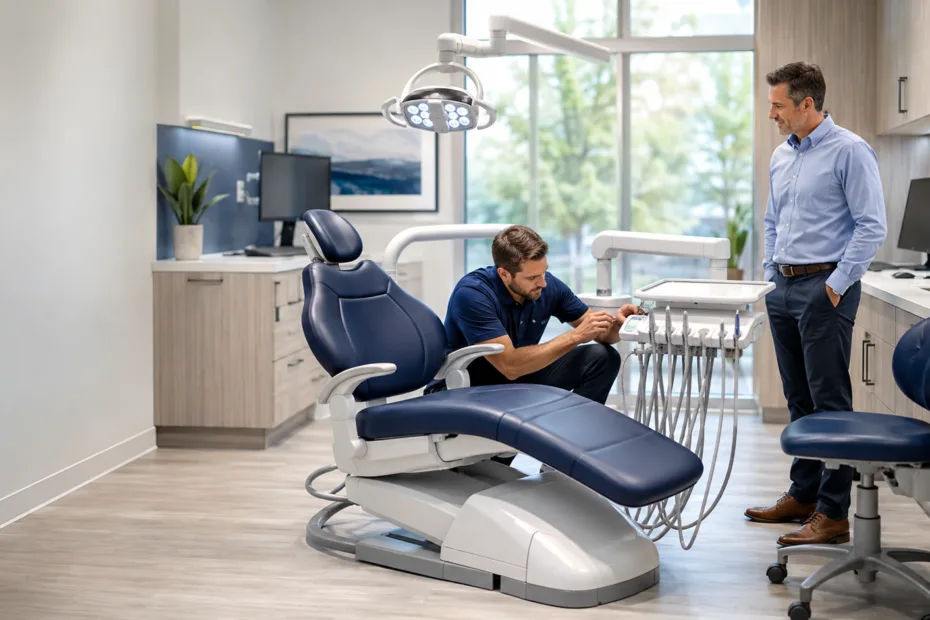
Upgrading a dental office does not always require a complete renovation or replacing every piece of equipment at once. Strategic improvements can help your team work more efficiently, provide a better patient experience, reduce equipment-related interruptions, and give your practice a cleaner, more modern appearance.
The challenge is deciding where to begin.
Should you replace your dental chairs? Upgrade your delivery systems? Improve your sterilization area? Invest in digital imaging? Sometimes, a relatively simple improvement—such as replacing damaged upholstery or updating an operatory light—can make a noticeable difference without consuming the entire equipment budget.
This guide explains how to identify the dental office upgrades that can deliver the most value for your practice.
Signs It May Be Time to Upgrade Your Dental Office
Dental equipment does not need to stop working completely before it deserves attention. Equipment that remains operational may still be creating inefficiencies, affecting patient comfort, or requiring increasingly frequent repairs.
Consider evaluating your office for upgrades if you are experiencing:
- Frequent equipment repairs or unexpected downtime
- Difficulty finding replacement parts for older equipment
- Worn, cracked, stained, or outdated upholstery
- Dental chairs that position slowly or inconsistently
- Poor visibility from older operatory lights
- Delivery systems that no longer support your preferred instruments
- Limited electrical outlets, plumbing connections, or storage
- A sterilization area that creates workflow bottlenecks
- Imaging equipment that slows down diagnosis or treatment
- Operatories that look noticeably different from one another
- Increasing patient volume that your current equipment cannot efficiently support
A professional equipment evaluation can help separate items that should be repaired from those that would be more cost-effective to replace.
Start With the Upgrades That Affect Daily Operations
The most valuable dental office upgrades are generally the ones your team and patients experience every day. Before focusing on cosmetic changes, identify the equipment or layout issues that interrupt procedures, slow room turnover, or create unnecessary movement.
Ask your team questions such as:
- Which equipment causes the most frustration?
- Where do procedures commonly slow down?
- Which rooms are requested or avoided?
- What equipment requires the most service?
- Are instruments and supplies located where they are needed?
- Is there enough room for the dentist and assistant to work comfortably?
- Are patients having difficulty entering, exiting, or remaining comfortable in the chair?
Your dental team can often identify workflow problems that may not be obvious from a management perspective.
1. Upgrade Aging Dental Chairs
The dental chair is the foundation of the treatment room. It affects patient comfort, clinician positioning, equipment placement, and the overall appearance of the operatory.
A chair upgrade may be worth considering when the existing chair has:
- Unreliable hydraulic or electromechanical movement
- Excessive noise during positioning
- Damaged controls or foot switches
- Loose armrests or headrests
- Limited positioning capabilities
- Recurring electrical or mechanical problems
- Upholstery that can no longer be properly repaired
- Components that are difficult to source
You may not need to purchase the newest chair available. A professionally refurbished dental chair can provide dependable functionality at a lower cost than purchasing new equipment. The right choice depends on your budget, desired features, equipment compatibility, and long-term plans for the practice.
2. Modernize Dental Delivery Systems
An outdated delivery system can limit instrument placement and create unnecessary reaching or repositioning during treatment. Upgrading the delivery system may improve ergonomics and help standardize the setup across multiple operatories.
Evaluate whether your current system provides:
- Convenient handpiece placement
- Reliable air and water controls
- Adequate instrument capacity
- A clean-water system
- Accessible controls
- An appropriate tray and work surface
- Compatibility with your existing dental chair
- Options for assistant instrumentation
Depending on the operatory, you may choose a traditional delivery system, Continental-style system, rear delivery configuration, side delivery unit, or mobile cart. The best layout is the one that supports how your team actually performs procedures.
3. Improve Operatory Lighting
Good visibility supports clinical precision and can reduce unnecessary repositioning. Older dental lights may have limited movement, inconsistent intensity, excessive heat, or components that are becoming difficult to replace.
Upgrading to a newer dental light may provide:
- Improved illumination
- More consistent light patterns
- Easier positioning
- Reduced heat output
- Better energy efficiency
- Touchless or simplified controls
- Compatibility with modern operatory configurations
Before selecting a replacement, confirm whether the light will be ceiling-mounted, wall-mounted, cabinet-mounted, or attached to the dental chair. The mounting configuration and electrical requirements should be reviewed before purchase.
4. Update Digital Imaging Equipment
Digital imaging can improve the speed at which images are captured, reviewed, stored, and shared. Practices still relying on aging sensors, film-based systems, or outdated software may benefit from evaluating newer imaging options.
Possible upgrades include:
- Digital intraoral sensors
- Intraoral X-ray units
- Handheld X-ray devices
- Panoramic imaging equipment
- Sensor positioning systems
- Imaging computers and monitors
- Updated imaging software
Compatibility is critical. Confirm that the sensor, computer, software, operating system, and X-ray equipment can work together before making a purchase.
5. Improve the Sterilization Area
The sterilization center is one of the busiest areas in many dental practices. An inefficient arrangement can create delays, unnecessary handling, and congestion.
A well-planned sterilization workflow should support the progression of instruments from contaminated to clean without unnecessary crossover.
Potential upgrades include:
- A larger or more efficient autoclave
- An ultrasonic instrument cleaner
- Instrument cassettes
- Improved storage
- Better lighting
- Dedicated preparation and packaging areas
- Updated cabinetry and countertops
- Clear separation of contaminated and clean zones
Remember that an ultrasonic cleaner prepares instruments for sterilization but does not replace the sterilization cycle performed by an appropriate autoclave.
6. Evaluate the Mechanical Room
The mechanical room may not be visible to patients, but it supports nearly every procedure performed in the office. Aging compressors and vacuum systems can affect multiple treatment rooms simultaneously.
Consider evaluating:
- Dental air compressors
- Vacuum systems
- Air dryers
- Amalgam separators
- Water-management systems
- Ventilation
- Electrical capacity
- Plumbing connections
Mechanical equipment should be sized according to the number of operatories, expected demand, and potential future expansion. Before replacing a system, have the existing utilities and installation requirements reviewed by qualified professionals.
7. Replace Worn Dental Chair and Stool Upholstery
New upholstery is one of the most visible and cost-effective dental office upgrades. Cracked, torn, stained, or flattened upholstery can make otherwise dependable equipment appear poorly maintained.
Reupholstering dental chairs and stools can help:
- Refresh the appearance of the operatory
- Improve patient comfort
- Coordinate colors throughout the office
- Extend the useful life of existing equipment
- Avoid the expense of replacing a functional chair
- Support an office rebranding or remodeling project
Practices can often choose from a wide range of healthcare-grade vinyl and premium upholstery materials. Coordinating the chairs, doctor stools, assistant stools, and other upholstered equipment can create a more consistent appearance throughout the office.
8. Update Cabinetry and Operatory Layout
Adding more equipment to an inefficient room will not necessarily improve productivity. Sometimes, the most effective upgrade is changing where equipment, supplies, and work surfaces are located.
When reviewing an operatory layout, consider:
- Dentist and assistant movement
- Patient entry and exit
- Instrument transfer zones
- Storage accessibility
- Computer and monitor placement
- Delivery-system position
- Electrical and plumbing connections
- Infection-control workflow
- Space for future equipment
Custom or modular dental cabinetry can help improve storage while making frequently used supplies easier to access. However, cabinetry should be planned around clinical workflow instead of appearance alone.
Should You Purchase New, Pre-Owned, or Refurbished Equipment?
Each option can play a role in a dental office upgrade.
New dental equipment
New equipment may provide current technology, manufacturer support, modern styling, and the longest anticipated service life. It may be the right choice for equipment with specialized technical or software requirements.
Pre-owned dental equipment
Pre-owned equipment can offer substantial savings, but its condition, service history, included accessories, and warranty coverage should be carefully reviewed.
Refurbished dental equipment
Refurbished equipment may provide a balance between affordability and reliability when it has been professionally inspected, repaired, cleaned, tested, and prepared for continued use.
Many practices combine all three options. For example, a practice might purchase new imaging technology while selecting refurbished dental chairs and reupholstering existing stools.
Plan Upgrades in Manageable Phases
If a complete office renovation is not practical, divide the project into phases.
A possible upgrade schedule could be:
Phase 1: Reliability and safety
Address failing equipment, recurring service issues, mechanical-room concerns, damaged electrical components, and anything that may interrupt patient care.
Phase 2: Workflow and efficiency
Upgrade delivery systems, sterilization equipment, storage, cabinetry, lighting, and instrument organization.
Phase 3: Patient experience
Replace worn upholstery, coordinate operatory colors, improve patient seating, and update visible equipment.
Phase 4: Technology and growth
Add digital imaging, additional treatment rooms, specialized equipment, or mechanical capacity needed for expansion.
Phasing the project allows the practice to control expenses while addressing the most important needs first.
Create an Upgrade Budget That Includes More Than Equipment
The advertised equipment price may not represent the complete project cost. Your budget may also need to include:
- Freight or delivery
- Removal of existing equipment
- Installation
- Electrical work
- Plumbing
- Carpentry or cabinetry modifications
- Computer and software updates
- Permits or inspections
- Staff training
- Future maintenance
- Accessories and replacement parts
Reviewing these costs before placing an order can help prevent delays and unexpected expenses.
Questions to Ask Before Purchasing Dental Equipment
Before committing to an upgrade, confirm:
- Will the equipment fit the available space?
- Is it compatible with the chair, delivery system, software, or utilities already in the office?
- What electrical, plumbing, air, vacuum, or mounting connections are required?
- Is installation included or available?
- What accessories are included?
- Is the equipment new, pre-owned, or refurbished?
- What warranty or return terms apply?
- Are replacement parts and service support available?
- How will the equipment be delivered?
- Will staff training be required?
These questions are especially important when combining components from different manufacturers or equipment generations.
Upgrade Your Dental Office With a Clear Plan
The best dental office upgrades solve real problems. They improve reliability, make clinical tasks easier, enhance patient comfort, and prepare the practice for future growth.
Instead of replacing equipment simply because it looks older, evaluate its condition, function, compatibility, repair history, and effect on daily operations. In many cases, repairing, refurbishing, or reupholstering existing equipment may be the right choice. In others, replacement may provide better long-term value.
Collins Dental Equipment can help dental practices evaluate new, pre-owned, and refurbished equipment options for individual operatories or larger office-upgrade projects. Our team can assist with dental chairs, delivery systems, lighting, cabinetry, mechanical-room equipment, custom upholstery, freight, and installation options.
Whether you are updating one treatment room or planning a complete office transformation, contact Collins Dental Equipment to discuss your goals and request equipment recommendations.